 Dellie
The Lab
Dellie
The Lab
Episode 3 of 10 · 15–16 Sep 2026 · 4 min read
The fly that turned only left
We spent two experiments hunting a broken neuron in the map. The broken part was ours.
Simulation onlyNo hardware in this episode.
Stripes
Flies steer by what they see. Show a fly stripes sliding past to one side, and it turns to follow them. It’s one of the oldest experiments in fly science, and a good test of whether our brain works the way a real one does.
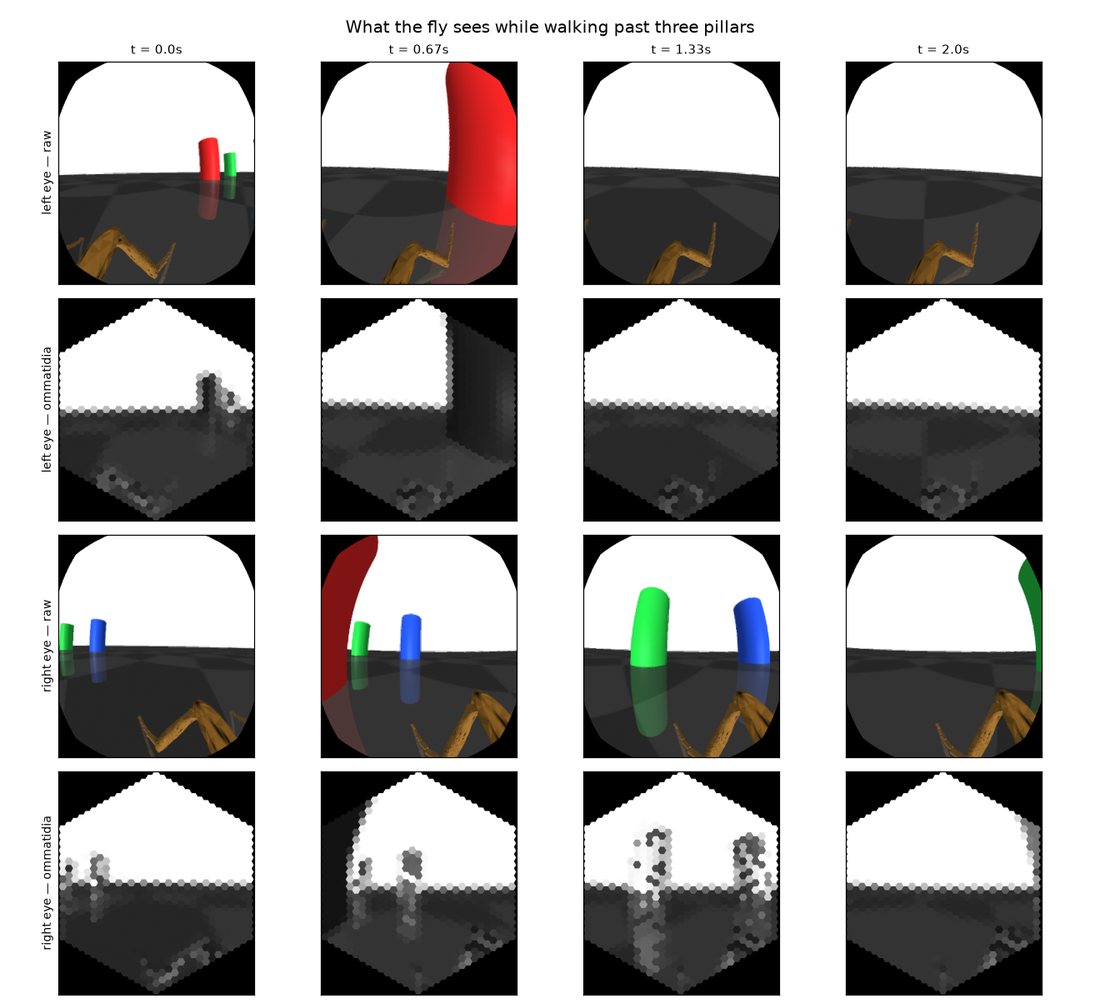
So our fly got eyes, built like a real fly’s: 721 tiny lenses on each side. Then we showed him moving stripes.
He turned left.
Stripes the other way: left again. Whatever the stripes did, he turned left.
The suspect
The obvious suspect was the map itself. Real scientific maps have gaps, and one steering cell, called DNb06, looked lopsided: 7,030 connections coming in on one side of the brain and only 749 on the other, with a note in the data that part of the cell was missing.
A damaged cell on one side would explain a fly that only turns one way. It was a good story. Two experiments went after it.
The first switched the suspect off. That removed about 40% of the one-sided signal: real, but not the whole answer.
The second tried to “repair” the cell, and we tested the repair against a sham: a fake repair that shouldn’t change anything. The repair didn’t beat the sham. So we couldn’t say it worked, however much we wanted to.
The twist
Then we followed the signal step by step, from the eyes to the legs. The main turning cell, DNa02, had been answering to both directions the whole time. Left stripes, left signal. Right stripes, right signal.
The brain was fine. The bug was in our own hand-written formula, the one that turns brain signals into leg movements. It had been reading the brain lopsidedly.
Once we read DNa02 directly, he turned both ways: 125 degrees a second one way, 134 the other.
He also got better at his actual job: he found and ate the sugar 85.7% of the time, up from 63.2%.
Reading the right neuron, he turns both ways, and eats more
What we kept
Two habits came out of this week, and they run the lab now:
Write the pass-or-fail rule before you look. We borrowed this from medical trials, where it’s called pre-registration. Before a trial starts, the team writes down what it will measure and what counts as success, so a disappointing result can’t be quietly re-scored afterwards.
We do the same for every test. The plan and its rule are saved and fingerprinted before the run, so nobody, human or AI, can move the goalposts after seeing the result.
- Always run a sham. It’s our version of a placebo: a fake treatment next to the real one, the only way to tell a real effect from wishful thinking.
When the result says the famous map has a flaw, check your own work first.