 Dellie
The Lab
Dellie
The Lab
Episode 9 of 10 · 20–28 Sep 2026 · 5 min read
“It’s working as hell”
At 1:33 a.m. the simulated fly moved a real, 3D-printed leg. Then it shook like mad.
Real hardwareand the simulated fly driving it.
This is the moment the whole project was for: a brain built from a real fly’s wiring, running on a computer, moving something in the real world.
It took three weeks from the first motor I ever moved to this clip. Here’s how the last stretch went.
One leg first
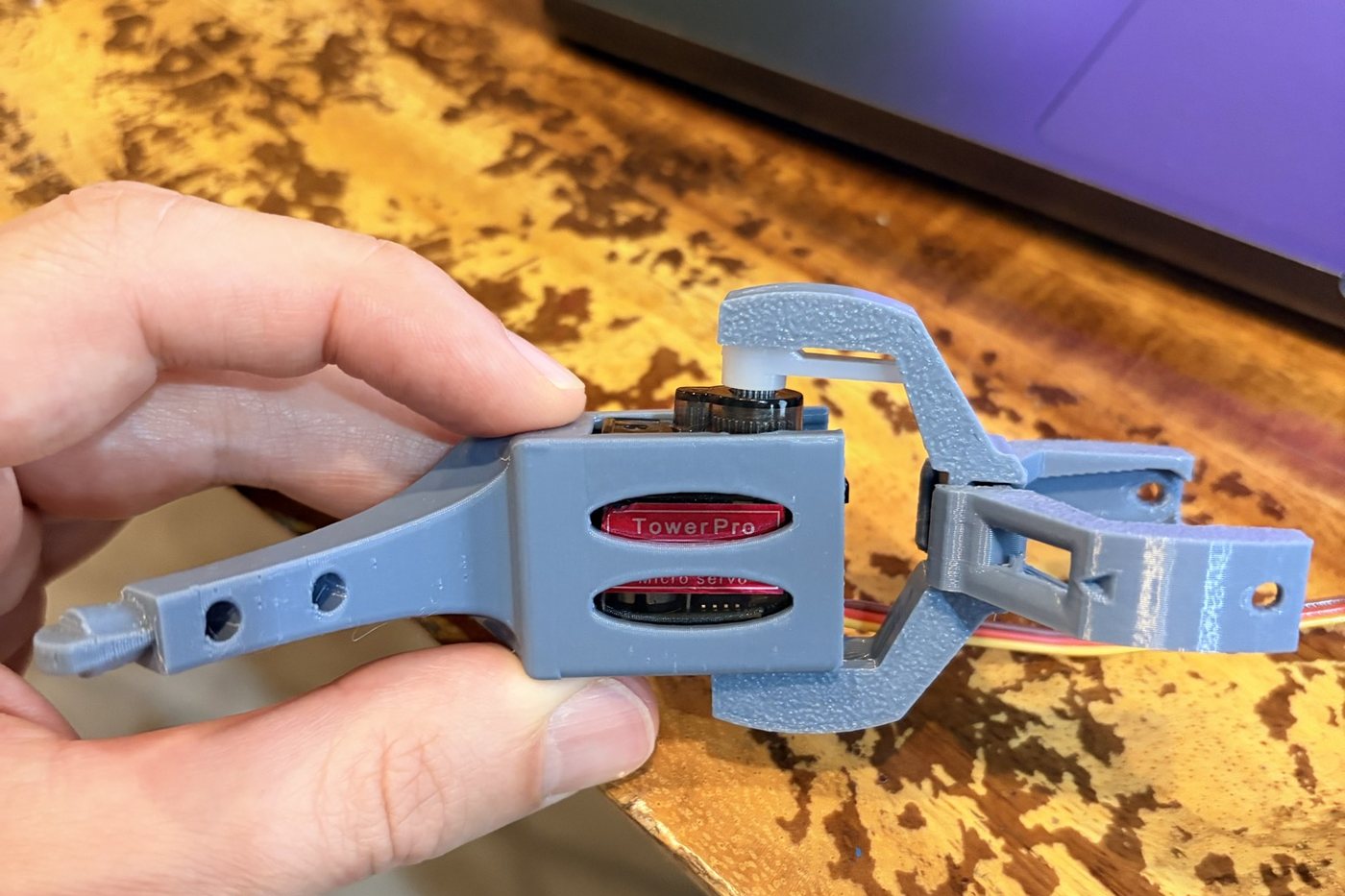
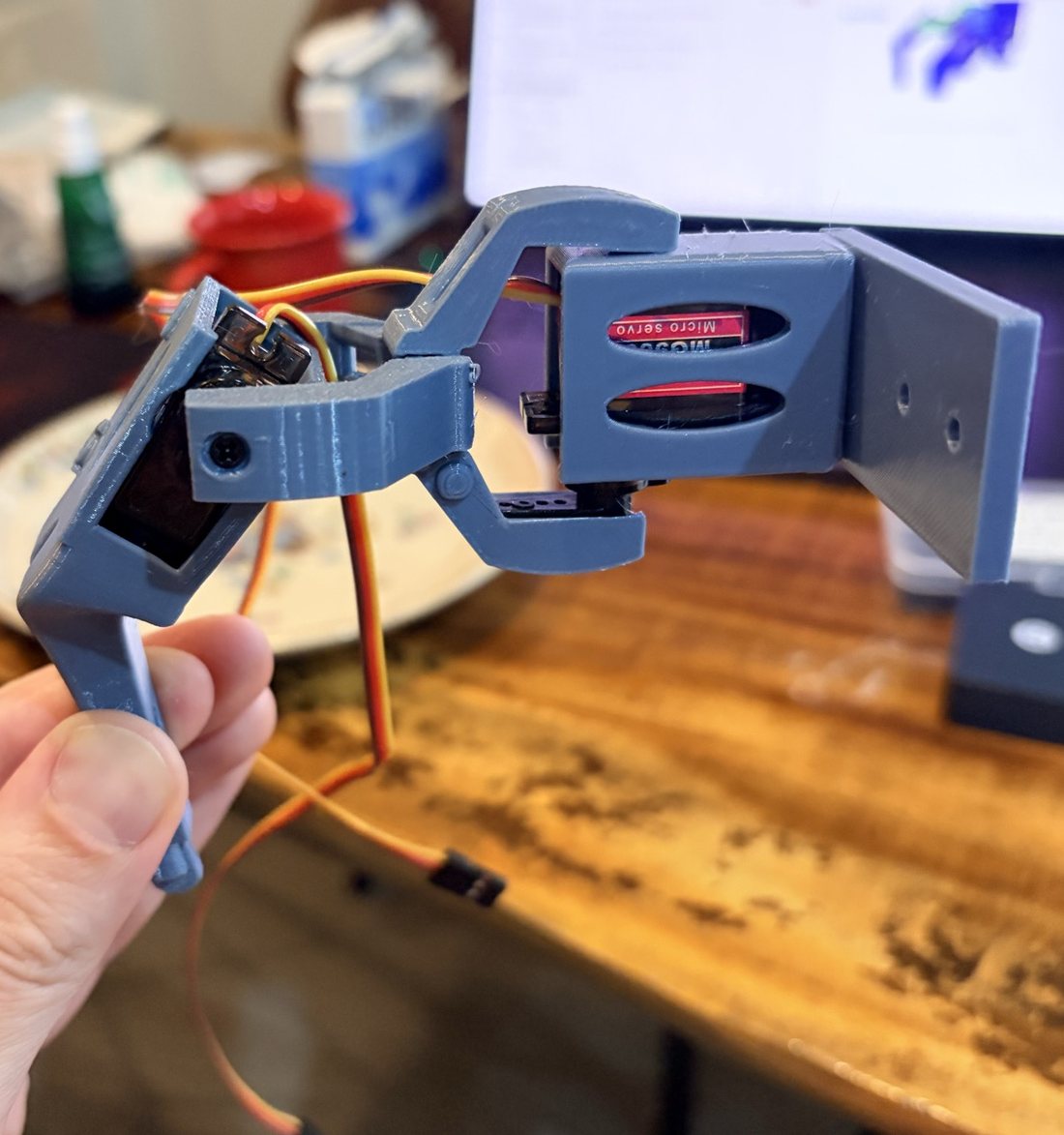
The plan was never a whole robot at once. First, one leg with two small motors called servos: a hip that swings the leg forward and back, and a knee that lifts the foot. A servo turns to whatever angle you tell it, and holds there.
The leg itself is an open design from the Vorpal hexapod project, printed on the same Bambu A1 that prints Dellie’s gifts.
The part that holds the hip motor wasn’t in their files for a body like mine, so we cut the motor box off the leg’s own 3D file and gave it a flat base.
The bridge
The fly lives on my computer. The leg lives on my desk. In between there’s a small program we call the bridge.
It watches one leg of the simulated fly, the left front one, and turns what it does into two angles: one for the hip, one for the knee. It sends them down a USB cable to a thumb-sized computer, which passes them to a board that drives up to 16 servos.
If no new command arrives for half a second, the leg goes back to the middle. That’s the safety net.
On the bench
The whole stack, from the brain on the computer to the leg on the desk.
- A Mac and a PCThe Mac runs the fly for the leg; the PC with an RTX 5090 runs the big experiments.
- Seeed XIAO nRF52840 SenseThe thumb-sized computer, about 21 × 18 mm. It takes the angles over USB.
- PCA9685 servo boardDrives up to 16 servos. The six-legged robot needs 12.
- MG90S servosThe hip and the knee, with metal gears. Twelve more are on the way.
- Bench power supplyNICE-POWER SPS3010: a steady 5 volts for the servos, never more than 2 amps.
- Bambu Lab A1The printer that makes Dellie’s gifts. It printed the leg.
- MultimeterZoyi VC17B+. Every volt in these episodes was measured with it.
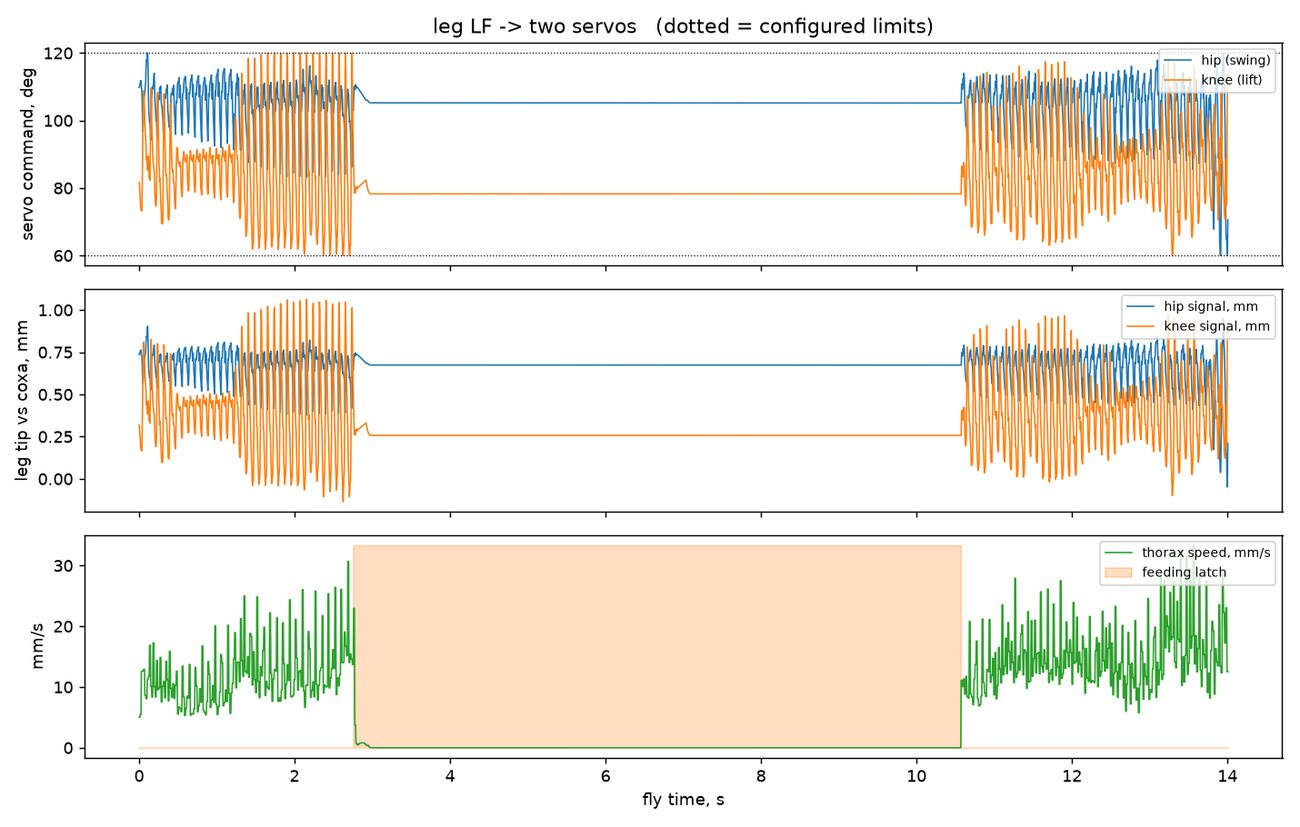
The leg goes still while the fly eats
Motor angles · degrees
Fly time · seconds
Leg tip · millimetres from the leg’s base
Fly time · seconds
Walking speed · millimetres a second
Fly time · seconds
Inspect the original lab chart
Tap the chart to enlarge it; use “Actual size” to read every label.
The first time: 20 September
At 22:14 on 20 September, a single bare servo on my desk followed the fly for the first time, live.
“It’s moving!!”
Before that, it had looked broken, for a funny reason. Two copies of the fly were running, one on my Mac and one on my PC. The web page was showing one of them, and the motor was following the other.
The whole leg: 28 September, 1:33 a.m.
A week of wiring brought a proper bench power supply, a servo board, and one wire that wasn’t soldered and cost me a late night. That’s Episode 8.
Now the whole printed leg ran, both joints, with the fly.
“It’s working as hell.”
Then it shook like mad.
A fruit fly takes about 12 steps a second. A small hobby servo can’t keep up with that. At a safe speed for the motor, a 43-degree knee swing allows about two steps a second.
Slowing down only the leg made it fall out of step with the fly on the screen, so the leg kept moving after the fly had stopped.
“My fly is mad.”
The sloth fly
My idea that night was a sloth fly. Don’t slow the leg; slow the whole world.
The next morning the team found the simulator already had a speed dial. At 10% speed the fly walks about 1.2 steps a second, which a servo can follow, and the screen and the leg stay in step. That’s the next test on the bench.
There’s a simpler question I haven’t checked yet: does the foot lift while the leg swings forward, the way a real one does?
Meanwhile, twelve more servos are on their way. The body for all six legs is already designed, and it already walks, on screen: