 Dellie
The Lab
Dellie
The Lab
Episode 1 of 10 · 12–13 Sep 2026 · 5 min read
A fly brain you can download
Nobody wrote a rule that says “eat”. The wiring did it anyway.
Simulation onlyNo hardware in this episode.
The map
A fruit fly has a brain the size of a poppy seed. Over the last few years, scientists have mapped all of it: every nerve cell, and every place where one cell connects to another. A map like that is called a connectome.
For a long time the maps came in pieces. One team, FlyWire, mapped a fly’s brain. Another mapped its nerve cord, the fly’s version of a spinal cord, which runs the legs. The two never met in the same map.
This year they finally did. The new map, called MaleCNS, follows one male fly from the eyes, through the brain and the neck, down the nerve cord to the legs.
Its data came out in June 2026, and the paper describing it was published in the journal Cell on 3 September. That’s when it went viral, and ten days later I started.
The version I run has 165,122 nerve cells and about 25.5 million connections between them. Anyone can download it.
Only the 2026 map joins the brain to the legs
One simple rule for every cell
A map isn’t a brain yet. It’s like a map of every road in a city: it tells you nothing about the traffic.
The trick comes from a 2024 paper by Shiu and colleagues, and it’s almost too simple. Give every cell the same rule: collect little signals from the cells connected to you, and when you’ve collected enough, fire a signal of your own, then reset. The map decides who talks to whom, and how loudly. Nothing else is added.
I started on the night of 12 September, after reading about another team, Eon Systems, running a fly’s brain inside a simulated body. By the next morning the first test was ready.
The first test
A fly tastes with its legs and its mouth. So I “fed” the brain some sugar by switching on the 21 cells that sense sugar, and watched one cell in particular: MN9, the motor neuron that makes a real fly stick out its tongue to drink.
It fired 82 times a second. Then the control: switch on 21 random cells instead. MN9 fired zero times.
Sugar makes the tongue neuron fire; random cells don’t
How often MN9, the tongue’s motor neuron, fires: times a second
Sugar reaches more cells, including the tongue neuron
Nerve cells that fired during the same test
Inspect the original cell-by-cell chart
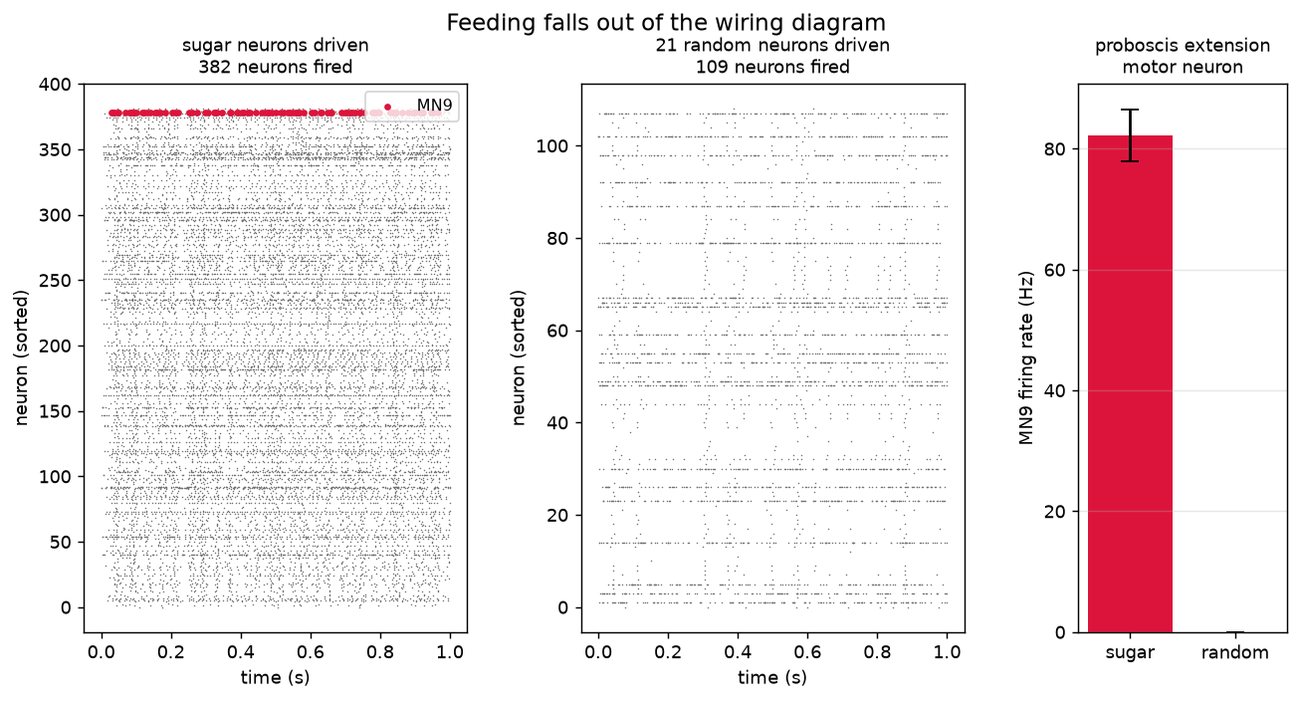
Tap the chart to enlarge it; use “Actual size” to read every label.
Nobody wrote a rule that says “if sugar, then eat”. It comes out of the wiring.
Then the brain caught fire
That first test ran on the older, brain-only map. The same day I stopped the team:
“Stop, we need to switch to a newer model: MaleCNS.”
On the new map, the whole brain lit up. Switching on 17 random cells set off about 20,000 others, a runaway fire.
It took a few fixes to calm it down. One was to scale every connection by the correction factor the map’s own authors use. Another was a pair of cells the data had marked as “go” when they should have been “stop”.
After that, sugar made the tongue neuron fire again, 55 times a second.
Watching it think
Numbers on a screen are hard to love. So a second AI on the team, Codex, built a viewer for the brain, called flyviz. It draws every nerve cell as a dot, and each one flashes when it fires.
That’s the clip at the top of this page: you can watch a taste of sugar travel through the brain.